GATE 2027 Registration Open August 14: 7 Things Aspirants Must Know

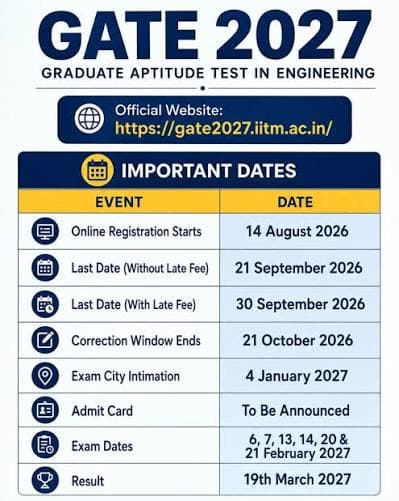
The Graduate Aptitude Test in Engineering (GATE) 2027 is set to enter its next phase as online registration opens on August 14, 2026. Conducted by IIT Madras, the examination will be held across six days in February 2027, with the results scheduled for March 19.
This year's examination comes with several changes, including a new Robotics and Automation (RA) paper, revised syllabi and updated two-paper combinations. The official GATE 2027 website lists 30 test papers, with candidates permitted to appear for one or up to two papers from the approved combinations.
For aspirants, the message is simple: registration is only the first deadline. The bigger task is choosing the right paper, understanding the revised syllabus and building a preparation strategy early.
GATE 2027: Key Dates at a Glance
Event | Date |
|---|---|
Registration opens | August 14, 2026 |
Regular registration closes | September 21, 2026 |
Extended registration with late fee | September 30, 2026 |
Admit card | January 4, 2027 |
Examination | February 6, 7, 13, 14, 20 & 21, 2027 |
Results | March 19, 2027 |
The dates are based on the current official GATE 2027 schedule and may be revised by the organising institute.
1. GATE 2027 Introduces a New Paper
One of the biggest changes this year is the introduction of Robotics and Automation (RA) as a new GATE test paper.
The development reflects the changing engineering and technology landscape. Robotics, automation, intelligent systems and industrial AI are increasingly connected to manufacturing, logistics, healthcare and advanced engineering.
For students, the new paper could provide another route into postgraduate study and specialised technical programmes.
At the same time, candidates should not select a paper simply because it is new or trending.
The choice should be connected to:
Undergraduate discipline
Target postgraduate programme
Career plans
Institution-specific eligibility
Personal subject strengths
GATE 2027 also states that revised syllabi have been issued for the test papers, making it important for candidates to work from the 2027 syllabus rather than older preparation material alone.
2. The Competition Is Already Significant
The scale of GATE can be seen from the previous cycle.
In GATE 2026, official paper-level data showed 259,922 registrations and 211,020 candidates appearing in Computer Science and Information Technology alone. Electronics and Communication Engineering recorded 115,448 registrations and 95,752 appearances, while Data Science and Artificial Intelligence had 91,764 registrations and 69,242 appearances.
Other major papers also attracted substantial numbers:
Civil Engineering: 97,486 registered; 76,385 appeared
Electrical Engineering: 81,947 registered; 65,801 appeared
Mechanical Engineering: 76,823 registered; 59,612 appeared
Data Science & AI: 91,764 registered; 69,242 appeared
These numbers show why preparation cannot be treated as a last-minute exercise.
The competition is also not identical across subjects. In GATE 2026, the General-category qualifying mark was 30 for CS, 28.7 for Civil Engineering, 27.7 for Electrical Engineering and 25.2 for Mechanical Engineering.
Important: qualifying marks are not the same as the score required for admission to a particular IIT, IISc or other institution.
3. Who Can Apply?
GATE 2027 has widened the relevance of the examination beyond traditional engineering degrees.
According to the official FAQ, students currently studying in the third year or higher of a government-approved programme in Engineering, Technology, Architecture, Science, Commerce, Arts or Humanities can appear, subject to the applicable rules.
There is:
No age limit
No restriction on the number of attempts
Option to apply for one or two papers
A requirement to follow the approved two-paper combinations when selecting two papers
Candidates should nevertheless check the eligibility requirements of the specific postgraduate programme they intend to pursue.
4. What Does a GATE Score Actually Offer?
A GATE score is not simply an entrance-test result.
The official GATE 2027 information states that qualified candidates can use scores for admission to Master's and doctoral programmes, including programmes in engineering, technology, architecture and relevant science, commerce, arts and humanities disciplines.
There can also be financial assistance.
For eligible M.Tech students, the GATE 2027 opportunities page lists financial assistance of ₹12,400 per month, generally for 22 months.
For eligible direct PhD candidates, the listed assistance is ₹37,000 per month for the first two years and ₹42,000 per month from the third to fifth year, subject to applicable rules.
GATE scores are also used by several Public Sector Undertakings in their recruitment processes.
However, there is an important distinction:
Qualifying GATE does not guarantee admission, scholarship or a PSU job.
Each institution and organisation has its own eligibility and selection criteria.
5. GATE 2027 Exam Pattern: Know the Numbers
Each GATE 2027 paper carries 100 marks.
The official structure provides:
15 marks — General Aptitude
85 marks — Subject-specific content
The examination papers are conducted in English.
Candidates can choose one or up to two test papers, but the second paper must come from an approved combination.
This makes paper selection an important strategic decision.
A candidate should not choose a second paper simply because two papers are allowed. The additional syllabus means additional preparation.
6. What Should Students Do Before August 14?
Registration should not become a source of avoidable mistakes.
Before applying, candidates should keep their details and documents ready and carefully read the official information brochure.
The application also requires candidates to upload a photograph and signature according to specified requirements. The official portal states that the same photograph will appear on the admit card and scorecard.
A simple pre-registration checklist
Before filling the form:
Check eligibility
Decide the primary paper
Review two-paper combinations
Read the revised 2027 syllabus
Keep identification and academic details ready
Check photograph and signature specifications
Use one application rather than creating duplicate forms
Save payment and application confirmation
The official FAQ specifically states that one email address can be used for only one application, while candidates opting for two papers should include both in the same application.
7. The Bigger Change Is Beyond the Examination
GATE 2027 arrives at a time when India's engineering sector itself is changing.
Robotics, semiconductor technology, data science, artificial intelligence, cybersecurity, advanced manufacturing and sustainable engineering are creating new areas of study and employment.
The addition of Robotics and Automation to GATE is therefore more than a minor examination update. It reflects how the boundaries between traditional engineering disciplines are changing.
But students should not abandon fundamentals in pursuit of every emerging technology.
Strong mathematics, engineering principles, analytical reasoning and problem-solving remain the foundation for advanced technical education.
The best preparation strategy is therefore a combination of conceptual depth + problem-solving + examination practice + awareness of emerging fields.
GATE 2027: The Numbers to Remember
30 — GATE 2027 test papers
100 — marks in each paper
15 — General Aptitude marks
85 — subject-specific marks
2 — maximum papers a candidate can take
3 years — GATE score validity
August 14 — registration opens
September 21 — regular registration deadline
September 30 — extended deadline
February 6–21 — examination window
March 19 — scheduled result date
What Aspirants Should Do Now
The GATE 2027 registration window is only the beginning.
Candidates should use August to finalise their paper, download the revised syllabus, analyse previous-year papers and create a realistic study timetable.
The strongest candidates will not necessarily be those who study the longest. They will be those who understand the syllabus, identify their weak areas, practise consistently and learn from mistakes.
With 30 papers, a new Robotics and Automation option and hundreds of thousands of candidates competing across major disciplines, GATE 2027 is shaping up to be another significant examination in India's postgraduate education landscape.
For students, the immediate priority is straightforward:
Choose carefully. Register correctly. Prepare early.
EduNex will continue tracking GATE 2027, entrance examinations, postgraduate admissions and the education trends shaping India's next generation of engineers and researchers.