IITs Expand Undergraduate Options with New-Age BS Programmes for Future Careers
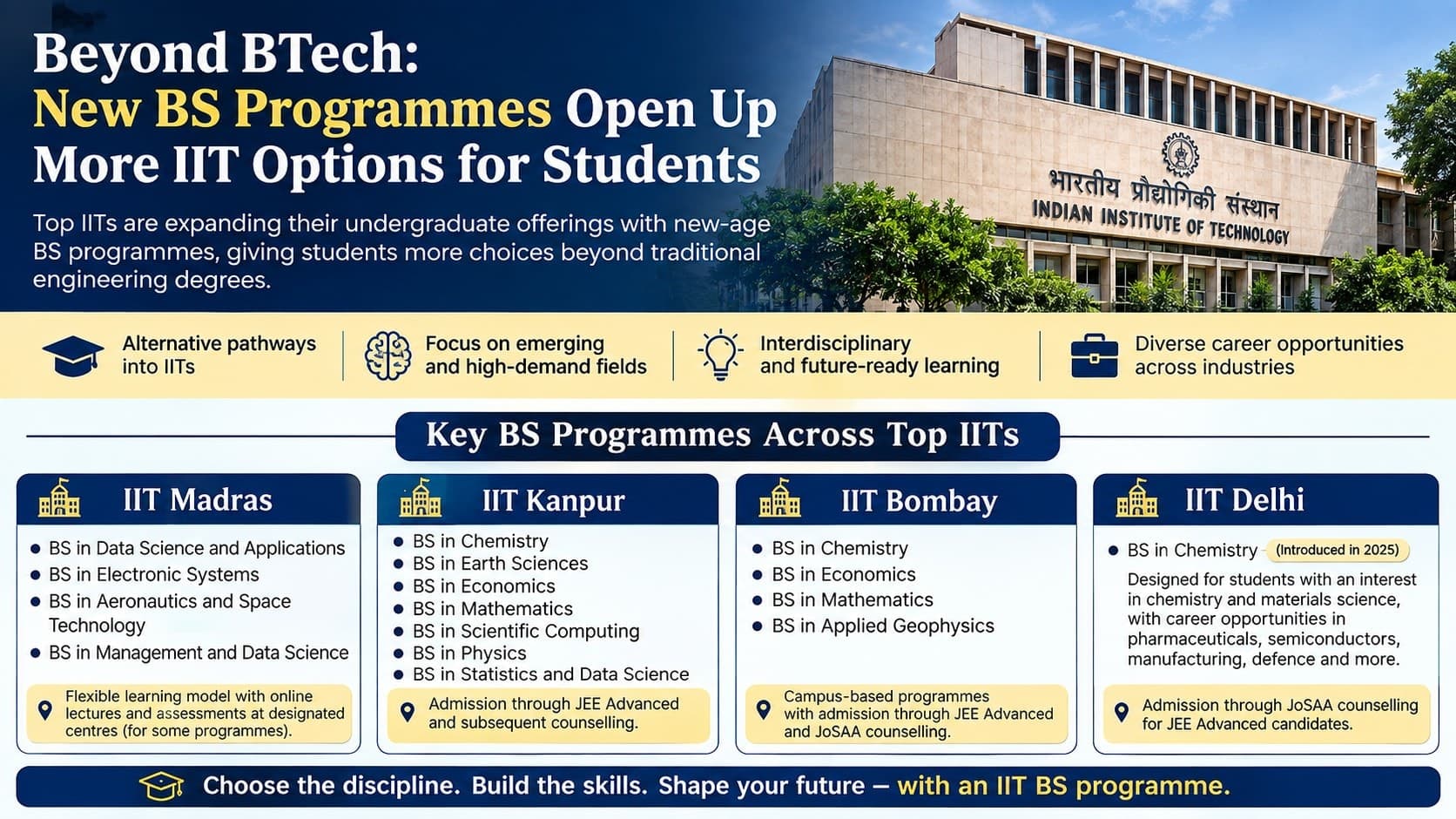
India’s premier engineering institutions are broadening their undergraduate offerings beyond traditional BTech degrees, with several Indian Institutes of Technology (IITs) introducing or expanding Bachelor of Science (BS) programmes in emerging fields. The move reflects a wider shift in higher education towards interdisciplinary learning, data-driven disciplines and skills aligned with the changing requirements of industry.
For students preparing for higher education in 2026 and beyond, these programmes offer an alternative route into the IIT ecosystem, particularly for those interested in mathematics, economics, data science, artificial intelligence, electronics, environmental studies and other emerging domains.
IITs broaden the BS programme landscape
Traditionally associated with engineering and technology degrees, IITs are increasingly using BS programmes to expand their academic portfolios. These programmes are designed to combine strong theoretical foundations with applications in industry and research.
One of the most prominent examples is the BS in Data Science and Applications at IIT Madras, which has attracted students from diverse educational backgrounds through its flexible online learning model. The programme demonstrates how IITs are experimenting with alternative approaches to undergraduate education while maintaining rigorous academic standards.
Other IITs have also introduced specialised BS degrees and interdisciplinary undergraduate programmes, creating more options for students who may not want to pursue conventional engineering disciplines.
Data science and artificial intelligence gain prominence
The growing importance of artificial intelligence, machine learning and big data has encouraged IITs to place greater emphasis on computational and analytical education.
BS programmes in data science provide students with foundations in programming, statistics, mathematics, data analysis and machine learning. Such programmes can prepare graduates for careers in technology, analytics, consulting, finance, research and product development.
The advantage for students is that they can build expertise in a high-demand area without necessarily following the conventional computer science engineering route.
Economics and interdisciplinary studies emerge as alternatives
The expansion is not limited to technology-focused disciplines. IITs are also offering undergraduate programmes in areas such as economics, which combine quantitative methods with social science perspectives.
An economics degree from an IIT can provide exposure to mathematical modelling, statistics, finance, policy and economic analysis. This interdisciplinary approach can be relevant to careers in financial services, consulting, public policy, analytics and research.
The emergence of such programmes indicates that IIT undergraduate education is gradually moving beyond the traditional engineering-only model.
Who can consider these programmes?
BS programmes can be particularly attractive to students who have strong interests in mathematics, analytical thinking and emerging disciplines but do not necessarily want to pursue a conventional engineering degree.
Students should, however, carefully examine eligibility requirements, admission routes, curriculum structure, duration, assessment methods and career pathways before applying. Eligibility varies between IITs and individual programmes, and not every BS programme follows the same admission process as the traditional BTech programmes.
For students appearing for competitive examinations, it is also important to understand whether a programme requires JEE-based admission, another entrance examination, an aptitude test or a separate application process.
Flexibility becomes a major attraction
One of the most significant developments associated with IIT BS programmes is greater flexibility in how students learn.
The IIT Madras BS programme, for instance, has demonstrated the potential of combining online education with structured academic evaluation. Such models can allow students to access IIT-level education while providing greater flexibility than conventional residential programmes.
This could become increasingly important as higher education institutions experiment with blended and technology-enabled learning models.
What students should look for before choosing a BS programme
The IIT brand alone should not be the deciding factor. Students should evaluate the programme based on their academic interests and long-term career plans.
Important factors include the curriculum, faculty expertise, practical exposure, internships, research opportunities, industry interaction, programme delivery model and progression options.
Students should also consider whether they want to pursue employment immediately after graduation or continue towards postgraduate study and research.
A BS programme in data science, for example, may suit a student interested in analytics or AI, while economics could be better suited to someone interested in finance, consulting or policy.
A changing IIT ecosystem
The expansion of BS programmes reflects a broader transformation taking place across Indian higher education. As employers increasingly value specialised skills, analytical ability and interdisciplinary knowledge, universities are developing programmes that go beyond traditional degree structures.
For IITs, the move also creates an opportunity to serve students interested in a wider range of academic disciplines.
For students, it means that the IIT ecosystem is no longer limited to the familiar choices of mechanical, civil, electrical or computer science engineering. New undergraduate pathways are opening in fields that are closely connected to the future of work.
What lies ahead
As technology continues to reshape industries, the demand for graduates who can combine technical knowledge with analytical and interdisciplinary skills is expected to grow. IITs are likely to continue experimenting with new programme structures to respond to these changes.
For aspiring undergraduate students, this expanding portfolio means there are now more ways to build an IIT education around their interests and career ambitions.
The key message, however, is simple: students should choose the discipline first and the institution second. A strong academic fit, relevant skills and a clear understanding of career opportunities will ultimately matter more than the degree label alone.
Related Articles
UGC NET Results 2026 for 84 Subjects to Be Announced This Week
UGC NET Results 2026 for 84 subjects are expected this week as NTA prepares final answer keys, while three subjects face September re-exams.

Why AI Literacy Is Becoming Essential for Every Student
Artificial intelligence is moving from the margins of education into its mainstream. What was once primarily a conversation about technology and automation is now becoming a question of curriculum, pedagogy, employability and educational equity.

India’s Global Campus Push Enters Its Most Crucial Phase
India’s higher education sector is entering a new era of internationalisation, with universities from the UK and Australia expanding into the country.