Degrees vs Skills: What Matters More to Employers?

For decades, a university degree has been viewed as the essential passport to employment. It signals academic achievement, subject knowledge and the completion of a recognised course of study. But as workplaces change, employers are asking a more practical question: What can a graduate actually do?
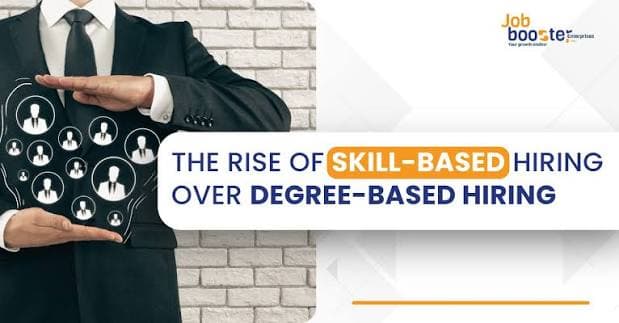
This does not mean degrees are losing their value. Rather, the relationship between qualifications and employability is changing. A degree may help a candidate get noticed, but skills, experience and demonstrated capability can increasingly influence whether that candidate gets selected and succeeds in the workplace.
The India Skills Report 2026 estimates graduate employability at 56.35%, highlighting the continuing gap between formal education and workplace readiness. The figure should not be interpreted as evidence that degrees are becoming irrelevant. Instead, it points to the need for stronger connections between what students learn in classrooms and what employers expect when they enter the workforce.
A Degree Still Matters
The debate around degrees versus skills can sometimes create a false choice.
For many professions, formal qualifications remain essential. Medicine, law, engineering, teaching and several other fields require specific educational credentials, regulatory recognition or professional training.
Even in sectors where formal qualifications are not mandatory, a degree can provide foundational knowledge, structured learning and access to opportunities that may otherwise be difficult to obtain.
The issue is not whether students should pursue degrees. It is whether a degree on its own is enough.
Increasingly, employers appear to want both academic foundations and evidence that candidates can apply what they have learned.
The Employability Gap
A graduate may understand the theory behind marketing but have never developed a campaign. A computer science student may know programming concepts but have limited experience building a working application. A business graduate may understand management principles but have never worked on a real business problem.
This is where the gap between education and employment can emerge.
Employers operate in environments where outcomes matter. They need people who can analyse a problem, communicate with colleagues, use relevant tools and contribute to projects.
Consequently, practical exposure is becoming an important complement to academic learning.
Skills Are Becoming Easier to Demonstrate
The rise of digital portfolios, internships, freelance work, online projects and industry certifications has made it easier for candidates to demonstrate their abilities.
A student can now showcase a software project on GitHub, a marketing campaign in a portfolio, a research project, a design collection or a business initiative.
This changes the traditional recruitment equation.
Instead of relying entirely on a résumé that lists qualifications, employers can increasingly examine evidence of capability.
That does not eliminate the importance of a degree. It adds another layer to the hiring decision.
What Employers Are Looking For
The skills employers value vary considerably by industry and role, but several capabilities appear across sectors.
Communication remains essential because employees need to explain ideas, collaborate and interact with customers and colleagues.
Problem-solving matters because workplaces rarely provide neatly defined academic questions.
Digital fluency is increasingly relevant as technology becomes part of everyday work.
Adaptability helps employees respond to changing tools, processes and business requirements.
Analytical thinking enables people to interpret information and make evidence-based decisions.
And increasingly, AI literacy is becoming part of digital capability, as employees learn to work alongside AI-enabled systems without surrendering human judgement.
Experience Can Start Before Graduation
Students do not need to wait for their first full-time job to develop workplace skills.
Internships, apprenticeships, industry projects, volunteering, competitions, student organisations and freelance assignments can all provide opportunities to practise professional skills.
Even academic projects can become valuable evidence when students can explain the problem they addressed, the approach they used and the outcome they achieved.
The important shift is from simply collecting activities to building demonstrable capability.
A résumé that lists ten certificates may be less persuasive than a portfolio showing how a student applied those skills to solve a real problem.
What This Means for Parents
For parents, the degree-versus-skills debate should not become a reason to dismiss higher education.
Instead, it provides another way to evaluate institutions.
Families can ask whether a university or college provides opportunities for internships, industry interaction, research, entrepreneurship, practical projects and career development.
The value of a degree increasingly depends not only on the qualification itself, but also on the learning environment surrounding it.
A strong institution should help students build both academic depth and professional readiness.
What Institutions Need to Change
Higher education institutions have an important role in closing the employability gap.
Curricula need to remain connected to developments in industry and society, while teaching methods should give students opportunities to apply concepts rather than simply memorise them.
Industry partnerships can support internships and live projects. Career services can help students understand recruitment expectations. Faculty development can strengthen teaching practices, while assessment methods can give greater weight to application and problem-solving.
Most importantly, institutions should be able to measure whether these interventions actually improve student outcomes.
The Role of Faculty
Faculty members remain central to this transition.
Employability-focused education does not mean turning universities into training centres for specific jobs. Higher education should continue to develop intellectual curiosity, disciplinary knowledge and critical thinking.
The challenge is to connect these foundations with application.
A professor teaching finance, for example, can use real-world business cases. A computer science faculty member can incorporate practical development projects. A humanities educator can strengthen research, writing and communication through applied assignments.
The goal is not to replace academic learning with vocational training, but to make learning more connected to the world beyond the classroom.
Technology Changes the Equation
Artificial intelligence is adding another layer to the skills discussion.
As AI takes over or assists with certain routine tasks, employers may increasingly value people who can frame problems, evaluate outputs, make decisions and work effectively with technology.
This means students need both technical and human capabilities.
Knowing how to operate a tool is useful. Understanding when to use it, questioning its output and applying professional judgement can be considerably more valuable.
Skills Without Foundations Are Not Enough
There is also a danger in overstating the importance of skills at the expense of education.
Short-term training can teach a specific tool, but tools change. A particular programming language, software platform or marketing technology may become less relevant over time.
Strong academic foundations provide students with the ability to understand concepts, learn new systems and adapt as industries evolve.
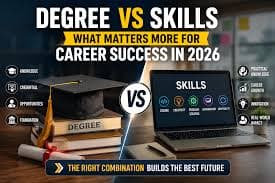
The most resilient graduate is therefore unlikely to be the person with only a degree or only a collection of technical skills. It is more likely to be someone who combines knowledge, practical capability and the capacity to keep learning.
The Real Question for 2030
By 2030, recruitment may look considerably different from the traditional process of reviewing degrees and résumés.
Employers may place greater emphasis on portfolios, assessments, projects, internships, demonstrated competencies and problem-solving ability. AI may also change how recruiters identify and evaluate candidates.
For students, this makes preparation more important than prediction.
They do not need to know exactly which jobs will exist several years from now. They need to develop capabilities that remain useful when the nature of work changes.
The EduNex Perspective
The degree-versus-skills debate should therefore not be framed as a competition between two alternatives.
Degrees provide foundations. Skills demonstrate application. Experience connects the two.
For EduNex, the more important question is how educational institutions can create that connection effectively. Institutional quality should increasingly be examined through evidence of student learning, industry engagement, faculty capability, internships, research, career outcomes and graduate progression.
As India's education and employment landscape evolves, students and parents need information that goes beyond rankings and placement claims. They need to understand what an institution actually enables a student to learn, practise and achieve.
The future of employability may belong neither to the degree-holder nor to the skills-only candidate.
It may belong to the graduate who can demonstrate what they know, show what they can do and continue learning when the world of work changes.
Fact-Check Sources
India Skills Report 2026
2026 fresher-hiring and recruitment trends