What Employers Really Want From Fresh Graduates

A degree gets a graduate to the starting line. It does not necessarily prepare them for what happens next.
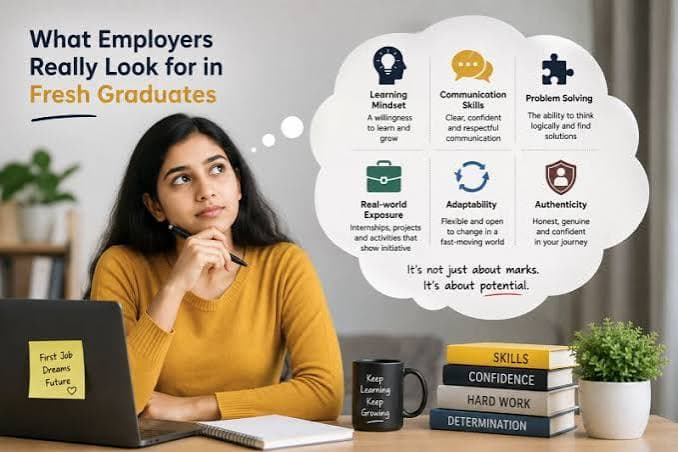
For years, campus recruitment in India followed a familiar pattern: students completed their degrees, companies assessed their academic records and selected candidates for entry-level roles. Today, that process is becoming more demanding. Employers are looking beyond marks and qualifications to understand whether a graduate can think independently, communicate clearly, solve problems and learn quickly once inside the organisation.
The challenge is reflected in a striking disconnect. A recent HirePro report found that 68% of students believe they are ready to contribute from their first day at work, while only 9% of employers agree. More than half of employers surveyed said fresh graduates require at least a month of structured training before they can contribute meaningfully.
This does not mean graduates are unprepared or that universities are failing. It suggests that students and employers may be using very different definitions of "job readiness."
The First Expectation: Be Ready to Learn
Employers do not expect a fresh graduate to know everything.
What they increasingly expect is the ability to learn.
A graduate entering a company may encounter unfamiliar software, processes, clients and problems within the first few weeks. Technical knowledge acquired at university can provide a foundation, but the ability to absorb new information and apply it quickly becomes equally important.
This is particularly relevant as AI and digital technologies change workplace tasks rapidly. Recent industry commentary in India has highlighted adaptability, critical thinking and problem-solving as increasingly important as AI takes over more routine technical work.
For a fresher, saying "I don't know this yet, but I can learn it" can be more valuable than pretending to have every answer.
Employers Want Evidence, Not Just Claims
A résumé can say that a student is a good communicator, team player or problem-solver.
A project can demonstrate it.
This is why internships, academic projects, competitions, freelance assignments, research and portfolios are becoming increasingly useful. They give employers something tangible to assess.
A student who has built a website, analysed a dataset, organised an event, conducted research or developed a business proposal can explain what they encountered, what decisions they made and what the result was.
That evidence can reveal more about workplace readiness than a list of certificates.
Technical Skills Still Matter—But Context Matters More
The shift towards broader employability skills should not be misunderstood as a rejection of technical capability.
Employers still need people with strong knowledge of engineering, finance, design, healthcare, technology, marketing, science and other disciplines.
The difference is that technical knowledge increasingly needs to be applied in context.
A software graduate may need to understand not only how to write code, but how the product serves a customer. A finance graduate may need to interpret data rather than simply understand accounting concepts. A marketing graduate may need to use digital tools while understanding audience behaviour.
The strongest fresh graduates can connect what they know with why it matters.
Communication Is a Workplace Skill, Not a Soft Extra
Many graduates underestimate how much of professional life involves communication.
A technically strong employee may still struggle if they cannot explain an idea to a manager, write a clear email, present a recommendation or communicate a problem before it becomes a crisis.
Employers therefore increasingly value graduates who can make their thinking understandable to others.
Communication does not mean speaking constantly or using sophisticated vocabulary. It means being clear, concise and purposeful.
Problem-Solving Begins When the Question Changes
Academic problems often come with clearly defined questions.
Workplace problems rarely do.
A client may describe a symptom rather than the actual problem. A manager may provide an objective without explaining how to achieve it. A project may change halfway through.
Fresh graduates need to become comfortable with this uncertainty.
Employers want people who can ask the right questions, break a problem into manageable parts, explore alternatives and make a reasonable decision with the information available.
That is a very different skill from simply producing the correct answer in an examination.
AI Has Changed What "Digital Skills" Mean
Being comfortable with technology is no longer enough.
As AI becomes part of everyday work, graduates increasingly need to know how to use AI tools responsibly, evaluate their outputs and understand their limitations. The India Skills Report 2026 places overall graduate employability at 56.35% and identifies AI adoption and digital fluency among the forces reshaping India's workforce.
For employers, the ideal fresher is unlikely to be someone who simply knows how to generate content with AI.
It is someone who can identify where AI adds value, provide the right context, check the output and apply professional judgement.
In other words, AI should increase a graduate's capability, not replace their thinking.
The Ability to Work With People
A first job is rarely an individual exercise.
Fresh graduates have to work with colleagues who have different personalities, experiences and working styles. They may need to receive feedback, handle disagreement, collaborate across departments and contribute to group decisions.
This is where qualities such as empathy, reliability, listening and teamwork become important.
They may not appear prominently on a university transcript, but they can have a significant impact on whether a new employee becomes effective within a team.
Initiative Can Separate One Candidate From Another
Employers also notice what candidates do without being asked.
A graduate who identifies a problem, explores a solution, volunteers for responsibility or learns a relevant tool independently demonstrates initiative.
This does not require entrepreneurial ambitions.
It can be as simple as improving a process during an internship, creating a better way to organise a student project or learning a software tool because it is relevant to a career goal.
Initiative signals curiosity—and curiosity is valuable in an environment where no job description remains completely static.
Employers Are Not Abandoning Degrees
The rise of skills-based hiring does not mean academic qualifications have become irrelevant.
Recent campus-hiring data suggests that India's transition to skills-first recruitment remains incomplete. Only 21% of companies surveyed by HirePro said they had completely moved away from using academic scores in campus recruitment.
The more realistic picture is a combination of both.
A degree establishes academic foundations. Skills demonstrate application. Projects and experience provide evidence. Personal qualities influence how effectively someone works with others.
Employers are increasingly looking at the complete picture.
What Fresh Graduates Should Stop Doing
There is also value in considering what employers may not want.
They do not necessarily need candidates who have accumulated dozens of unrelated certificates.
They do not need someone who claims proficiency in every technology listed in a job description.
And they do not expect a fresher to behave like a five-year experienced professional.
What they need is credibility.
A candidate who understands their own strengths, acknowledges gaps, demonstrates relevant experience and shows a willingness to learn can make a stronger impression than someone whose résumé is impressive but difficult to substantiate.
The University Has a Role to Play
The employability conversation cannot be placed entirely on students.
Universities and colleges also need to create opportunities for students to practise professional skills before graduation.
Industry projects, internships, experiential learning, research, career services and updated curricula can help students understand how academic knowledge operates in real settings.
Recent industry-academia initiatives in India are increasingly focusing on combining academic foundations with hands-on experience and technology skills, reflecting the growing importance of closer alignment between education and employment.
The objective should not be to turn universities into corporate training centres. It should be to ensure that graduates can connect knowledge with application.
The Real Definition of a Job-Ready Graduate
Perhaps the biggest change is that "job readiness" can no longer be defined simply by a degree, percentage or placement test.
A genuinely prepared graduate should be able to enter an unfamiliar environment and begin learning.
They should be able to understand a problem, ask useful questions, communicate their thinking, work with others and use available tools—including AI—responsibly.
They should also be comfortable admitting what they do not know.
That combination of knowledge, capability, curiosity and adaptability is what makes a graduate valuable beyond the first job.
Placement is an outcome, but it is not the whole story.
The more useful questions are: What skills did students develop? What practical experiences did they receive? How closely does the curriculum reflect industry needs? Are graduates able to adapt after joining the workplace? What happens to them six months or one year after recruitment?
These questions can provide a more meaningful picture of institutional effectiveness.
The Takeaway
Employers are not looking for finished professionals when they recruit fresh graduates.
They are looking for people who can become effective professionals.
That means strong foundations matter. Technical skills matter. But so do communication, problem-solving, adaptability, initiative, collaboration and the ability to keep learning.
For students, the message is encouraging: you do not need to know everything before your first job.
You need to demonstrate that you can learn, contribute, take feedback and grow.
That may be the most important skill employers are really looking for.
Sources
India Skills Report 2026
HirePro, The State of College Hiring in India 2026
Recent industry perspectives on AI, adaptability and graduate readiness